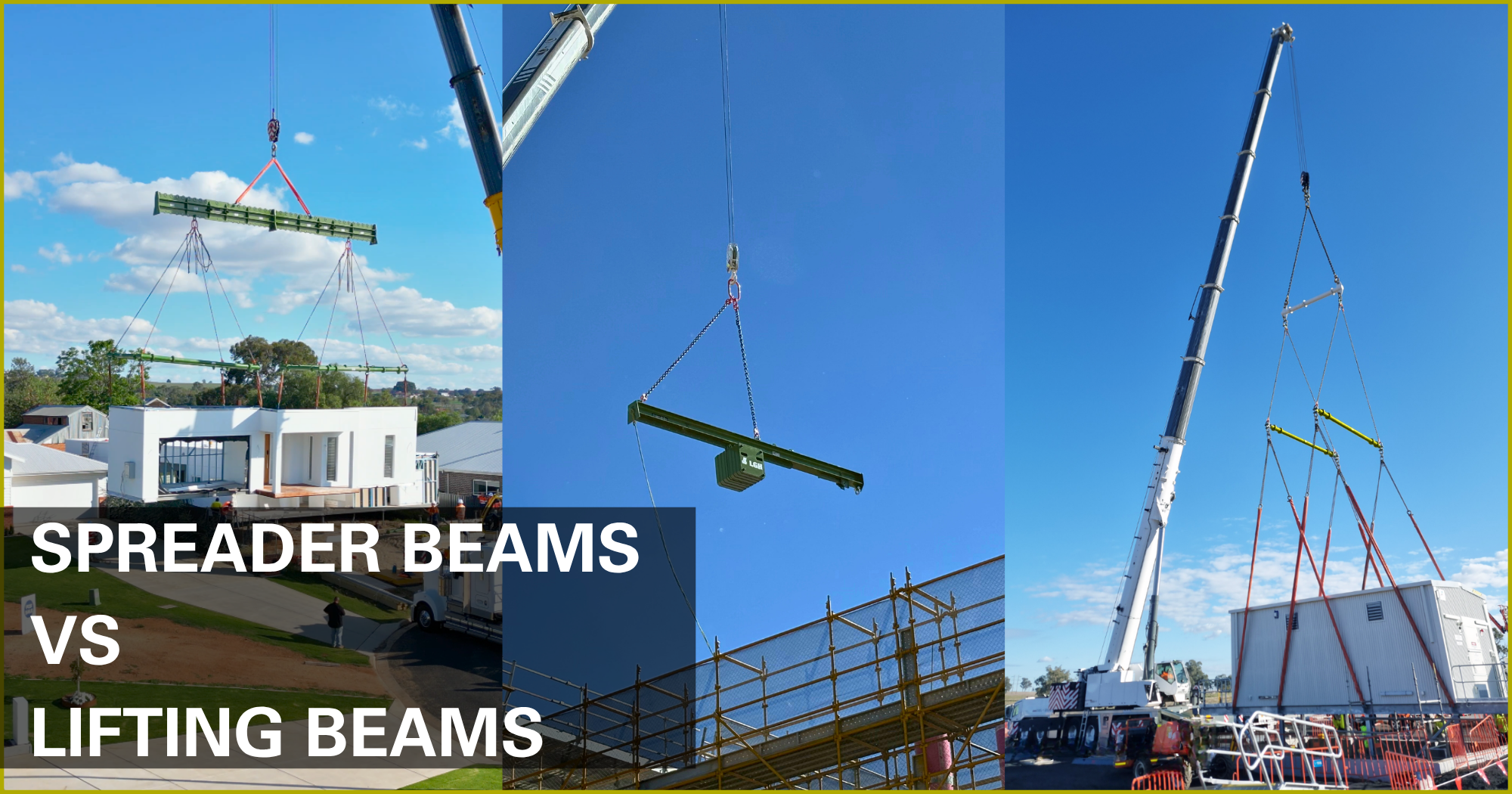
What’s The Difference?
When planning a lift, choosing the right below-the-hook equipment can have a significant impact on how the load is controlled, the headroom required and the overall rigging arrangement.
Spreader beams and lifting beams can appear similar, but they transfer forces differently and are suited to different lifting applications. Understanding those differences can help determine the most practical solution for the load, site conditions and available lifting space.
How Does a Spreader Beam Work?
A spreader beam typically uses two upper slings connected between the beam and the crane hook. During the lift, the beam primarily works in compression, while the upper slings transfer the load back to the crane hook.
This design allows spreader beams to handle substantial loads while keeping the beam relatively lightweight.
Modular spreader beams offer additional flexibility. Sections can be combined in different configurations to accommodate varying load dimensions and lifting requirements.
LGH Australia offers Modulift modular spreader beams across a wide range of capacities and configurations, making them suitable for everything from construction and infrastructure projects to complex heavy lifts.
How Does a Lifting Beam Work?
Unlike a spreader beam, a lifting beam is generally connected directly to the crane hook from one or more lifting points on the beam, with the load suspended from lifting points below.
This means the beam is primarily subjected to bending and shear rather than compression.
One of the key advantages of a lifting beam is its ability to provide a compact rigging arrangement. With less upper rigging required, lifting beams can be particularly useful where available headroom is limited.
However, not every lifting beam is the same.
Different configurations can be designed to solve specific lifting challenges. For example, an Offset Lifting Beam allows the crane connection to be positioned away from the centreline of the load, providing a practical solution when overhead structures or other obstructions prevent a conventional straight lift.
Multi-point lifting beams can also provide flexibility when loads have different lifting point arrangements or when load positioning needs to be carefully controlled.
Headroom and Site Restrictions
Available headroom is often one of the biggest factors when choosing between the two.
Spreader beams require space above the beam for the upper slings to achieve the required sling angles. Where sufficient vertical clearance is available, they provide an efficient solution for wide and high-capacity loads.
Lifting beams can provide a more compact arrangement because the crane hook can connect much closer to the beam. This makes certain lifting beam configurations particularly useful in workshops, beneath structures or on sites where overhead clearance is restricted.
Where the challenge isn’t simply low headroom but an overhead obstruction, specialist configurations such as an Offset Lifting Beam may provide another option.
Modular Flexibility
Another consideration is how frequently the lifting arrangement needs to change.
Modular spreader beams can be configured at different lengths by combining interchangeable components. This makes them particularly useful for rental applications where load dimensions and project requirements vary.
Lifting beams can range from relatively straightforward fixed configurations through to more specialised designs intended to accommodate particular lifting points, clearances or load geometries.
Which Should You Hire?
There isn’t a universal answer. The right equipment depends on the lift.
Important considerations include:
- Weight and dimensions of the load
- Location and configuration of lifting points
- Available headroom
- Overhead or surrounding obstructions
- Required span
- Crane capacity
- Rigging arrangement
- Site access and handling requirements
For wide or particularly heavy loads with adequate overhead clearance, a modular spreader beam may provide the most practical solution.
Where headroom is restricted, lifting points require a different arrangement or site obstructions complicate a conventional lift, a lifting beam or specialist configuration may be more appropriate.
Finding the Right Configuration
Every lift presents a different combination of load, space and site constraints.
LGH provides access to a specialist range of below-the-hook lifting equipment, including Modulift modular spreader beams, Multi-Lug Lifting Beams and Offset Lifting Beams, supported by in-house testing and certification.
Speak with the LGH team about your load and lifting requirements, and we can help identify the right equipment configuration for the job.


